
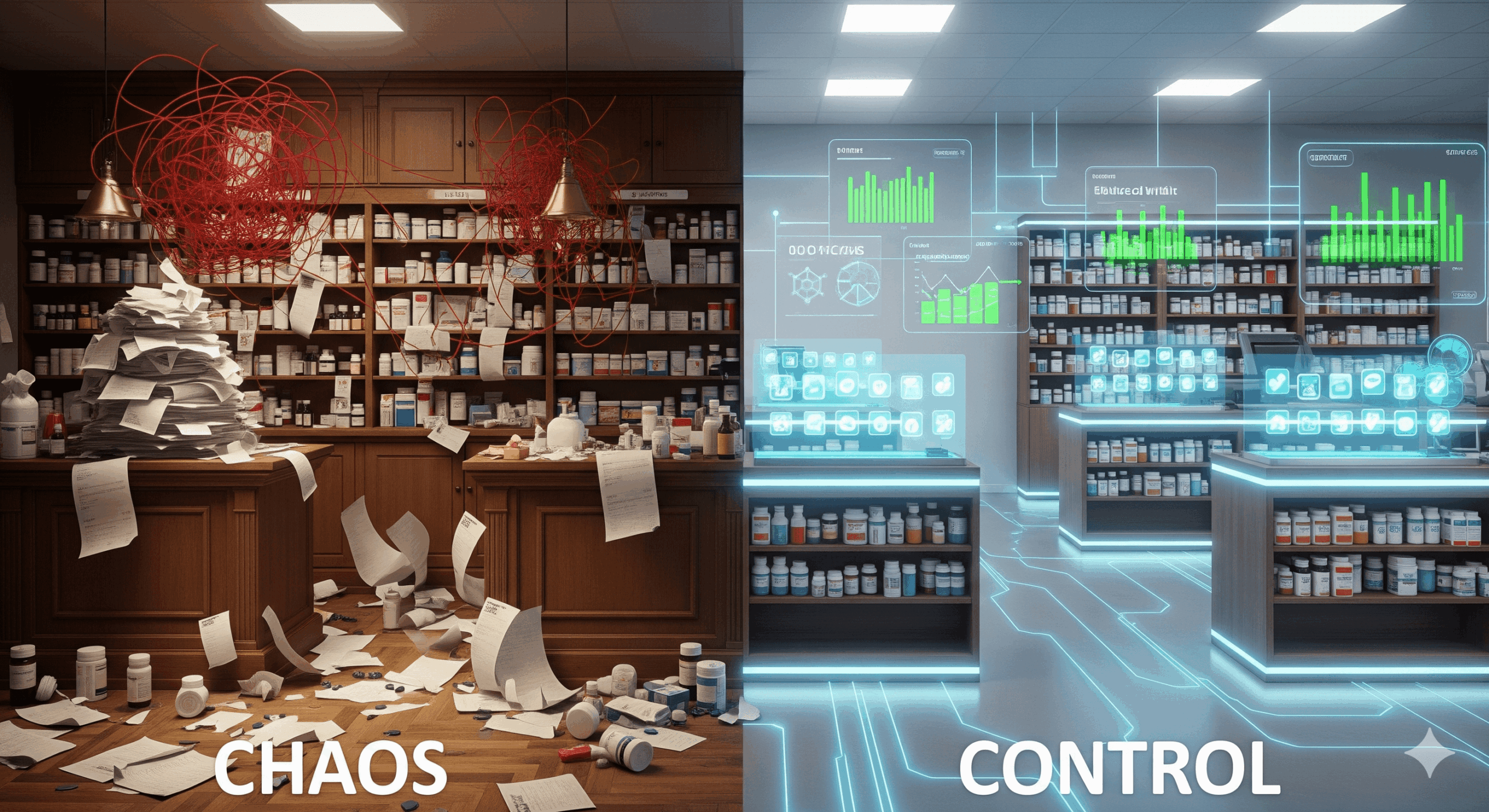
Executive Summary: The modern hospital pharmacy operates at a high-stakes intersection of patient care and complex business logistics. While it is a critical center for healing, it is also frequently a source of significant operational chaos, patient risk, and financial leakage. This playbook provides a strategic blueprint for transforming your pharmacy from a reactive, high-risk environment into a proactive, high-control center of excellence. We will dissect the points of failure in traditional systems and outline a clear, technology-driven strategy—built on visibility, integration, and automation—to achieve a zero-error, zero-waste operation.
Chapter 1: The State of Play: Analyzing the Chaos
Before implementing a solution, a leader must first understand the true anatomy of the problem. The “chaos” in a typical hospital pharmacy is not random; it is the predictable result of outdated systems straining to keep up with modern demands.
1.1 The Prescription Pitfall
The journey of a prescription is the pharmacy’s most critical workflow, yet it is often the most fragile. In a manual or semi-digital system, this process is fraught with risk:
- Illegibility & Ambiguity: Hand-written prescriptions are a notorious source of error. A misinterpreted dosage or medication name can lead directly to an adverse drug event, compromising patient safety and exposing the hospital to liability.
- Manual Entry Errors: Even when prescriptions are legible, the process of manually typing them into a disconnected terminal introduces another opportunity for human error. A single misplaced decimal point can have critical consequences.
- Workflow Delays: The time spent deciphering notes, making confirmation calls to physicians, and manually entering data creates significant delays, leading to long queues and frustrated patients.
1.2 The Inventory Iceberg
What you see on the surface—an unexpected stockout of a common antibiotic—is just the tip of the iceberg. Beneath the surface lies a much larger mass of hidden costs and inefficiencies:
- Capital Imprisonment: Overstocking, often a panicked reaction to previous stockouts, ties up immense amounts of the hospital’s capital in non-liquid assets sitting on a shelf.
- The Inevitability of Waste: Without a “first-in, first-out” system enforced by technology, older stock gets pushed to the back. This leads to predictable and significant financial losses from expired medications and supplies.
- The Time Tax: Your highly-trained pharmacy staff are forced to spend an inordinate amount of time on low-value tasks: manual stock counts, searching for misplaced items, and generating reports by hand, stealing time that should be spent on clinical verification and patient counseling.
1.3 The Silo Syndrome
The most pervasive issue is that the pharmacy often operates as an island, disconnected from the rest of the hospital’s operations.
- Clinical Disconnect: When a nurse on an inpatient ward needs medication for a patient, the process is often a flurry of phone calls and paper requisitions, with no digital trail or real-time status update.
- Financial Leakage: For admitted patients, medications are dispensed from the pharmacy but often fail to be accurately recorded on the final bill. Every missed charge is pure revenue leakage, silently draining the hospital’s profitability.
Chapter 2: The Technology Blueprint: The eghealth Solution
Control is achieved when the right technology is applied to a sound strategy. The eghealth Pharmacy Management Software is not just a tool; it is a comprehensive, integrated ecosystem designed to address every point of failure and empower your team.
2.1 The Digital Bridge: Integrated Prescription & Dispensing
This is the foundational play to eliminate prescription errors. The eghealth system creates a direct, unbroken digital link from the physician to the pharmacist.
Execution: A doctor generates an electronic prescription for a patient1. That prescription is assigned a unique ID and barcode2. When the patient arrives at the pharmacy, the pharmacist simply scans the barcode or enters the ID to instantly retrieve the complete, accurate prescription3. There is no handwriting to interpret and no manual data entry required4. This single play cuts the risk of dispensing errors dramatically while accelerating service.
2.2 The Command Center: End-to-End Inventory Lifecycle Management
This is how you conquer the inventory iceberg. eghealth provides a suite of tools that give you absolute, real-time control over every item in your supply chain.
- Play 1: The Requisition & Demand Engine. Eliminate paper and phone calls. A nurse in the Indoor Patient Department (IPD) can send a medicine requisition for an individual patient directly to the pharmacy through the system. Other departments and sub-stores can also send digital requisitions with a full draft and approval workflow. The system centralizes all demands, giving you a clear, institution-wide view of what’s needed, where, and when.
- Play 2: The Procurement Pipeline. Connect your purchasing directly to your needs. Based on approved demands, the system facilitates the generation and approval of Purchase Orders (POs). Goods are then received against that specific PO, creating a perfect audit trail from need identification to stock replenishment.
- Play 3: Real-Time Stock Intelligence. Replace manual counts with live data. Stock levels are automatically updated with every transaction—be it an issue, a return, or a new receipt. At any moment, an administrator can generate a Current Stock report, a Batch Wise Stock Report, or a full Stock Ledger Report to get an precise snapshot of the pharmacy’s health.
2.3 The Financial Safeguard: Integrated Billing & POS
This play plugs the revenue leaks permanently. The pharmacy module is seamlessly integrated with the hospital’s financial backbone.
Execution: When medicine is dispensed, the system captures the transaction through an integrated Point of Sale (POS) that can handle multiple payment methods. For inpatients, issued medications are automatically logged against their account. The system maintains a complete payment record for all pharmacy billing and can generate detailed billing reports. Every single item dispensed is an item billed.
Chapter 3: Measuring the Win: The ROI of Control
The return on investment from this transformation is profound and felt across the entire organization.
- For the Patient: A dramatic increase in safety and a significant reduction in wait times, leading to a better, more trustworthy healthcare experience.
- For the Pharmacist: A less stressful, more professional environment. The automation of tedious tasks frees them to perform high-value clinical work, improving job satisfaction.
- For the CFO: A hard stop to revenue leakage, optimized cash flow from better inventory management, and drastically reduced waste from expired stock.
- For the CEO: A more efficient, more profitable, and safer hospital. This builds a stronger reputation in the community and positions the institution as a leader in modern healthcare delivery.
Conclusion: Your Next Move
Chaos is the default state of any complex system left unmanaged. Control, however, is the result of a deliberate strategy powered by the right technology. By implementing a modern Hospital Automation Software like eghealth, you are not just buying a product; you are executing a strategic playbook to build a world-class pharmacy.
It’s time to move your pharmacy from a center of chaos to a center of control. Contact us to see a live demonstration of the eghealth Pharmacy Management playbook in action.